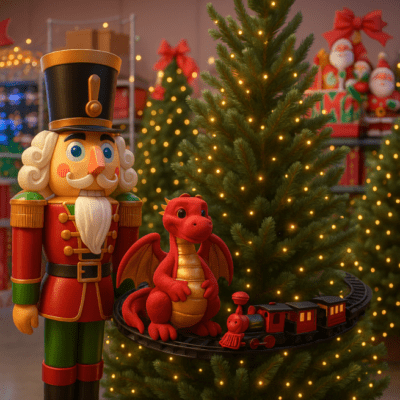
24 Days of Martin – Day 06: Nutcrackers
The past few weeks had been fun. Mom and Martin had been going into all sorts of different stores and shops to take photos of Martin with Christmas decorations. Martin was trying to decide what his 24 Days of Martin – Day 06 would be so he was scrolling through the images looking for inspiration. Then he saw it. Tall. Straight. Serious. Big Hat. And a monster of a mouth. He found the photo of the person sized Nutcracker while he was in Home Depot playing with trains.
Martin knew Nutcrackers came from Germany. All the good Christmas stuff did! In fact, when it came to Christmas, if you weren’t sure of where something came from, you could just say Germany! And most of the time you would be correct! But Martin didn’t know anything else about Nutcrackers. I mean, yeah, they crack nuts, he thought to himself, but what are they for? There are simpler tools to use to crack nuts he wondered.
So Martin wandered into his parents library. They had books from different places and authors. Many different genres and a good mix of fiction and non-fiction. They even had an old set of encyclopedias!
Martin looked around, scanned the books on the shelves, and decided on three. He took them to the large comfy chair next to the table and sat down to research Nutcrackers.
Martin started with the encyclopedia first. He had pulled the ‘N’ edition off the shelf and thumbed thru the pages until he found the entry for Nutcrackers. He read that Nutcrackers have been used for thousands of years. Before official tools were made, the first nutcrackers were simple hammers or stones and people just smashed the nuts open. Then metals were used to craft nutcrackers. There were screw styles which worked like a vice, ratchet styles which resembled car jacks, and nutcrackers which look like modern pliers. No matter the style, the job of a nutcracker is to squeeze nuts until they crack open.
A legend from the 17th Century in Germany says, “A wealthy farmer held a contest to see who could crack a particularly stubborn nut. A soldier tried. A carpenter tried. Finally a tiny, clever wooden puppet cracked open a nut by using leverage and his hinged mouth. The farmer rewarded the puppet’s maker, and from then on, nutcrackers symbolized: cleverness, strength, protection, and good fortune. Nutcrackers are carved from wood to look like local authority figures: Kings, police officers, soldiers, and local elected officials. People liked the crafted nutcrackers and enjoyed the idea of the carvings “cracking down” on evil and offering protection and luck.
The style we see today, was refined by Wilhelm Füchtner around 1870 who also began making the first mass produced nutcrackers. Martin thought for a moment to do some math in his head, like his Dad often did. “2025 minus 1870 is 155. So 155 years ago. Wow!”, Martin muttered to himself.
It is believed Füchtner was inspired by the 1816 story “The Nutcracker and the Mouse King” written by E.T.A. Hoffman. This story, and possibly Füchtner’s nutcracker makeover, inspired the ballet, “The Nutcracker” with music written by Tchaikovsky. This ballet made the nutcrackers even more popular and turned them into Christmas symbols instead of just tools.
Martin knew from shopping with his mom that nutcrackers now come in all sorts of designs: sports figures, animals, snowmen, famous singers, celebrities, and more. From his experience with the nutcrackers in his home, he knew most of these nutcrackers didn’t work and were for decoration only. Martin flipped through the other two books he had selected but they didn’t tell him anything new. He returned the books to their shelves and ran to leave the library.
“Mom! Mom! Guess what I just found out about nutcrackers!!!”, Martin yelled as he ran towards the kitchen.


- 1
- 2