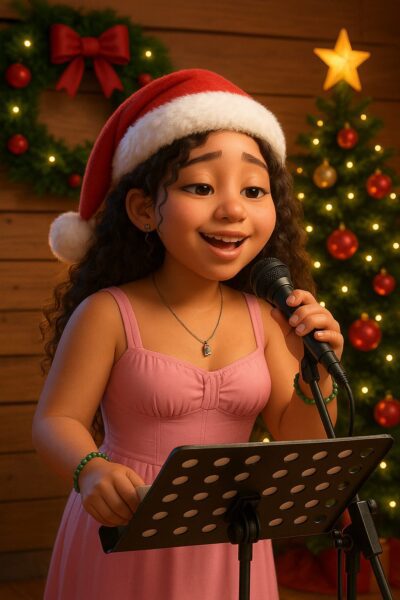
24 Days of Martin – Day 08: Christmas Carols
Martin got a WhatsApp message from his friend Karen. She and her mom were singing Christmas Hymns in church. Martin messaged Karen back asking what her favorite was. Her reply was “Hark! The Herald Angels Sing”. Martin looked up from his messages confused. How could that be her favorite hymn when he knew it was a Christmas Carol. He heard it when he played Christmas music on the radio.
Martin went to look for Mom or Dad. Mom was sewing stockings for more decorations. Martin didn’t want to interrupt, and didn’t want to hear about stockings. Right now he was interested in Carols. Martin decided to ask Mom where Dad was as it was easier than trying to look for him. “Dad went to the hardware store. He needed more bolts and screws for his latest project.”, she replied.
Bummed he couldn’t ask anyone for the answers, Martin wandered into the library. He looked through the bookshelves, found a music book about carols and pulled out the Encyclopedia ‘C’. He jumped into the comfy chair and started to look through the music book. It seemed to just be lyrics and chords for playing the guitar. He sighed and opened the encyclopedia, flipped through the pages, and found “Carols”.
‘Carols’, Martin learned, came from the Greek “choraulein” (a circle dance accompanied by flute) or the Old French “carole”, a circular dance song with singing. Ancient cultures sang these songs as the prepared for and celebrated the Winter Solstice. The songs were festive and a way to spread joy and goodwill during the short days of light and the long nights of winter.
Christianity adopted and adapted these songs and carols, and Latin hymns became part of the church services in about 125 AD, or about 1900 years ago. The first know hymn was written by St. Ambrose about 1700 years ago. This hymn was ‘Veni redemptor gentium (Come, Redeemer of the Gentiles), was written to be sung in Latin, structured into eight verses, and was sung only by choirs.
St. Francis of Assisi made carols available to the public around 800 years ago by translating carols into native languages through his Nativity Plays. Minstrels and singers would wander through towns singing these easy songs. Focusing on Nativity, the Virgin Mary, and the three Wise Men, the minstrels brought carols to the people and made them popular. Wassailing, which is groups of singers wandering from door to door, are thought to be a direct descendant of these minstrels.
In the 1600’s Oliver Cromwell, Lord Protector of the Commonwealth of England, Scotland and Ireland, believed Christmas was too permissive, unholy, and wasteful. He banned Christmas and Christmas Carols in England for 13 years. It was only when Charles II returned to the throne in 1660 when Christmas, Christmas carols, and Christmas celebrations returned with the lifting of the ban. Martin wondered if this had anything to do with the #13 being bad luck. He made a mental note to look that up on a later day.
The Victorian era and the 1800s brought back a Christmas revival. New carols were written, such as: “Silent Night” in 1818; “Jingle Bells” in 1857; “O Holy Night”, in 1847, and others. Some carols were written about real events: “Good King Wenceslas” is about Saint Wenceslaus I, a duke from Bohemia; “I Heard the Bells on Christmas Day” was written by Henry Wadsworth Longfellow and is about bells ringing during the American Civil War; and “Go, Tell It on the Mountain” began as an African-American spiritual song passed down orally and brought to the pubilc by the Fisk Jubilee Singers. And perhaps, one of the most famous Victorian Christmas traditions wasn’t a carol at all – it was Charles Dickens’ “A Christmas Carol”.
Most of the Christmas carols and songs we know today are from the 1940’s to 1960s, known as the “golden age” of Christmas Carols. Carols started to become more commercialized, less sacred and more secular, and more focused on Santa and wintertime.
Some of the best known songs are:
1940s:
- “White Christmas” – Bing Crosby (1942) – became the best-selling single of all time
- “Have Yourself a Merry Little Christmas” (1944) – from “Meet Me in St. Louis”
- “The Christmas Song (Chestnuts Roasting)” – Nat King Cole (1946)
- “Here Comes Santa Claus” – Gene Autry (1947)
- “Rudolph the Red-Nosed Reindeer” – Gene Autry (1949)
1950s:
- “Frosty the Snowman” – Gene Autry (1950)
- “Sleigh Ride” – Leroy Anderson (music 1948), Mitchell Parish (lyrics 1950)
- “It’s Beginning to Look a Lot Like Christmas” (1951)
- “I Saw Mommy Kissing Santa Claus” (1952)
- “Jingle Bell Rock” – Bobby Helms (1957)
- “Rockin’ Around the Christmas Tree” – Brenda Lee (1958)
1960s:
- “A Holly Jolly Christmas” – Burl Ives (1964)
- “Do You Hear What I Hear?” (1962)
- “Little Drummer Boy” – recorded by many in the 1960s
Today, Christmas carols are a mix of traditional carols and popular songs. The most famous being “All I Want for Christmas Is You” by Mariah Carey (1994).
Martin shivered as he read the last line. He was so tired of that song. He heard it at the grocery store, and at the hardware store, and even at school because the choir was practicing for the Christmas Carnival!!
Martin stood up. Stretched. He placed the books back on their proper shelves. Then he walked back to his Mom, still in her sewing room, and asked if she would play the “Old Fashioned Christmas” music they had. He wanted to be in the Christmas spirit but didn’t want to hear anymore of Mariah Carey!


- 1
- 2