24 Days of Martin – Day 22: Piñatas
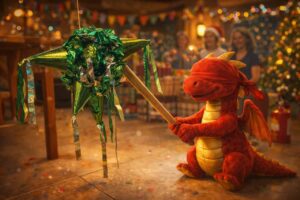
While snooping for hidden presents in the garage, Martin discovered a Christmas tree piñata leaning next to some boxes. It was huge: nearly as tall as Martin! It was covered with bright green tissue paper, carefully shaped into branches, and decorated with handmade ornaments.
“Found the piñata for the library?” Mom asked, appearing in the doorway with her keys in her hand. “Do you like it?”
“It’s awesome!” Martin said. “But Mom, I just realized something. We always have piñatas at birthday parties and other celebrations, but I have no idea why we have them at Christmas.”
Dad appeared behind Mom, grinning. “Oh boy, here we go. Did someone ask about history?”
Martin groaned good-naturedly. “I didn’t ask about history. I asked about piñatas.”
“You may not know it, but you did ask about history,” Dad said, rubbing his hands together. “Because piñatas have one of the coolest origin stories ever. It involves China, Italy, Spain, and Mexico. Would you like to hear the story?”
“Ummmm…” started Martin.
Dad picked up the Christmas tree piñata and started to place it in the trunk of Mom’s car. “I’m going to keep Mom company while she drives to drop off the piñata at the library. Come with us, and I’ll tell you both the story!”
Martin and Mom exchanged a knowing glance. Once Dad got excited about a history story, there was no stopping the telling. Martin opened the back door of the car and climbed in. “Sounds great,” deadpanned Martin.
Mom got into the driver’s seat, buckled her seatbelt, and started the car. She turned the heater on high to try to warm the car up quickly. Dad hopped into the passenger seat and, while already starting his “history of piñatas” story, grabbed and buckled his seatbelt.
“Ancient China used piñatas decorated with colored paper and ribbons during New Year celebrations. Their piñatas were shaped like cows, oxen, and other farm animals, and were filled with seeds. The people used sticks to break the piñatas, spilling the seeds and bringing good weather for the next harvest. Once the seeds spilled, they were burned, and the ashes were collected for good fortune and luck. The merchant and adventurer Marco Polo witnessed a New Year celebration and liked the idea of piñatas so much that he brought the concept with him when he returned to Italy.”
“Marco Polo was real?” asked Martin. “I thought that was just a game we played in the pool.”
“He’s real. He was a merchant from Venice who traveled along the Silk Road in Asia. His book, The Travels of Marco Polo, inspired future travelers and explorers,” explained Dad.
“I think you should focus on piñatas and tell us all about Marco Polo on his birthday when it’s celebrated in Venice,” remarked Mom.
“Good idea,” replied Dad. “Piñatas,” he stated, bringing his mind back to the topic, “were made out of clay pots in Italy and were called pignattas, which means ‘fragile pots.’ The pots were decorated with colored papers and ribbons to match the original piñatas in China. The piñatas became a part of the Lent celebrations, and the first Sunday of Lent was called ‘Piñata Sunday.’ The Roman soldiers would blindfold each other, taking turns hitting the pots with swords. The piñata tradition spread into Spain through Naples, which Spain ruled at the time.
Spanish missionaries traveled to Acolman, in central Mexico, in 1586. The Aztecs in Acolman were using clay pots decorated with feathers and filled with offerings to honor the birth of their god Huitzilopochtli. During the ceremonies, the clay pot was hit with a stick so that its contents spilled at the feet of Huitzilopochtli.
Friar Diego de Soria, wanting to convert the Aztecs to Christianity, asked for permission from the Pope to hold special Christmas masses starting December 16 and ending December 24. His request was granted, and Friar Diego de Soria combined the Italian and Spanish traditions with the existing Aztec ceremonies. A special seven-pointed star-shaped piñata was created for the last mass. This star resembled the Star of Bethlehem, which guided the Three Wise Men and shepherds to the baby Jesus. The star also reflected the Catholic Church’s teaching of the seven deadly sins:
- Each point represented one sin.
- The bright colors were to illustrate the temptation of evil.
- The blindfold showed one’s faith through believing without seeing.
- The stick to hit the piñata as a sign of virtue and willpower to overcome sin.
- The spinning and shouting showed how confusing temptation could be.
- The breaking of the piñata portrayed the defeat of temptation.
- The contents that spilled out were symbolic of the rewards of faith and the riches of heaven.
“In Mexico, Guatemala, El Salvador, Honduras, and among many Hispanic and Latino Americans, piñatas are still used on the last day of Las Posadas, a traditional nine-day procession which reenacts Mary and Joseph looking for an inn. At the end of the Posada, the participants show their faith and triumph over sin by using a piñata to ‘break the seven deadly sins’ and receive God’s grace.
“Not all piñatas were created as a seven-pointed star. Some were created as donkeys to honor the donkey Mary rode on her journey to Bethlehem. Today, piñatas are made from papier-mâché or cardboard and are shaped like cartoon characters or fun shapes like tacos, sombreros, jalapeños, ghosts, and more. Piñatas are used for birthdays, anniversaries, weddings, and year-round holidays.”
“WOW!” exclaimed Martin. “Piñatas are pretty important to Christmas celebrations!”
Absolutely,” Dad replied. “And they’re a lot of fun too!”
“Finally,” Martin grinned, “a tradition that doesn’t involve Germany!” and started laughing as they pulled into the parking lot of the library.